University of Sonora, Hermosillo, Mexico, March 13, 14 and 15
Encuentro for BINACOM 35 Anniversary Spring 2025:
Artificial Intelligence: Paths and Challenges in Communication, Hermosillo, Sonora, Mexico, March 13, 14, and15, 2025.
Call for Papers
For the 35th Anniversary of the Binational Association of Schools of Communication (BINACOM):
The Department of Communication Sciences at the University of Sonora enthusiastically invites you to the Binational Encuentro of Schools of Communication, which will take place on March 13, 14 and 15 in Hermosillo, Sonora, Mexico.
Objective:
The goal of this Encuentro is to continue strengthening academic ties between communication schools in the United States and Mexico, as well as to serve as a platform for reflecting on the paths and challenges posed by the advent of Artificial Intelligence in the various fields of Communication, particularly during this challenging time.
Aimed to:
The 2025 Binational Encuentro of Communication Schools is aimed at students, teachers, and researchers who wish to participate and reflect on the past, present, and future of communication in the world through academic presentations, as well as photographic, audiovisual, journalistic, and radio exhibitions.
We invite you to join us in this celebration, which that reaffirms our commitment to education, creativity and building new paths for communication.
Let’s make of this Encuentro an unforgettable moment!
Proposed General themes for the Encuentro:
• Impact of Artificial Intelligence on communication (media, research, teaching).
• Disciplinary analysis of migratory processes.
• Innovative and transdisciplinary research in the era of digital communication.
• Legacy media in the digital age
• Communication and disciplinary possibilities in emerging areas (health, environment, etc.).
• Digital media and new journalistic trends
• Organizational communication strategies for conflict resolution.
RESEARCH PROPOSALS
Submit a 300-word abstract of finished or in-process research, essays and methodological pieces.
Proposals will be submitted online.
Each proposal may have a maximum of three authors, and each author may submit up to two proposals to this event: one as the main author and one as a co-author.
The author of each accepted abstract will be required to present their work during the assigned panels or sessions. In the case of multiple authors, at least one author must attend the conference and deliver the presentation.
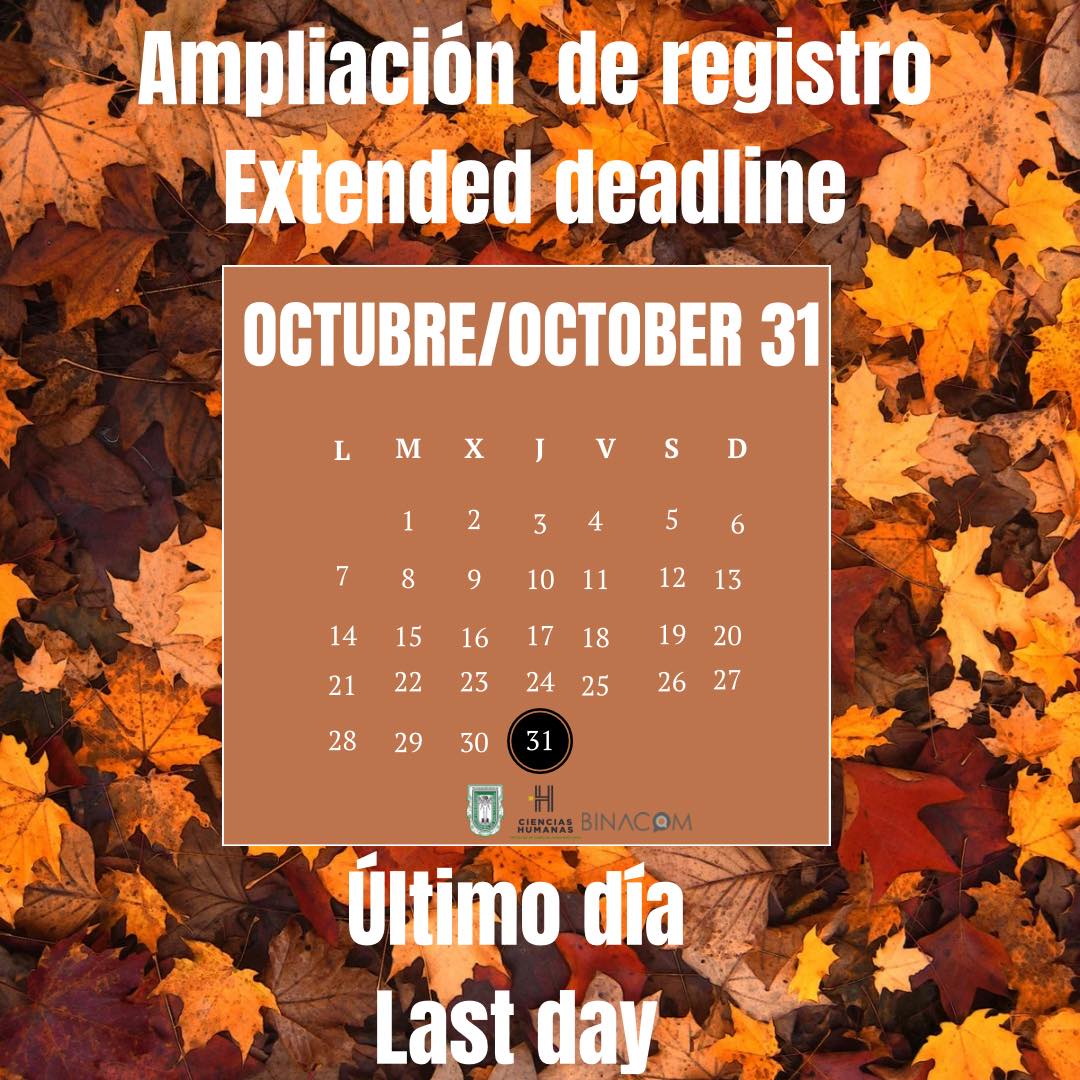
The deadline to receive proposals is February 28th and the results will be public on March 3rd 2025.
Information needed in the proposal:
- Name (s) and e-mail address of author (s)
- Topic and link to general themes
- Title
- Name of the academic institution and country of origin
- Professional title and academic degree of the author
- Conference Proceedings: Once abstracts are accepted, presenters must send a 5-page paper highlighting the findings and conceptual framework used in the research. These short papers will be made available to the public.
- Criteria for 5-page paper:
- The proposal should be original and not submitted anywhere else.
- The final proposal should be no longer than 5 pages including bibliography and should have the title and name of author (s), name of the institution, e-mail address, and short abstract of about 100 words, and three key-concepts.
- It should be written in Word for Windows or a compatible program, Times New Roman or Arial, size 12 and 1.5 line spacing.
- Citations and references should be formatted in APA style.
- Las propuestas deberán ser enviadas a lisset.oliveros@unison.mx vilma.campa@unison.mx , and manuela.matus@unison.mx
Exhibits and Showcases
Although the work submitted does not necessarily have to align with the central theme of this conference (artificial intelligence), participants are encouraged to make an additional effort to address these aspects, as well as other topics related to the most pressing issues in the binational region: migration, environment, social justice, border culture, citizenship, and transnational identities, among others.
Students and teachers are invited to participate in the exhibits and showcases with productions created between 2023 and the current year. Submissions must be sent no later than February 28, 2025. The selected works will be announced on March 3 via the email addresses provided by the participants.
SUBMISSION OF AUDIOVISUAL WORK (Cine and Video)
Submit short format videos (maximum 10-minute)
Genres:
Fiction (in any of its variants), non-fiction (documentary, feature story, scientific report, etc.).
Themes: Any topic considered appropriate or with social, political or cultural relevance.
During the Conference, there will be a session to project and document selected audio-visual work. The production team or a representative should be present in the sessions during projection and discussions.
Identifying information that you should include in your submission:
Title of the work
Genre
Synopsis
Duration or length
Name of the producer
Credits (name and attributions of each member of the production team)
Academic Institution
Format: should be video mp4
Those interested in participating should send their proposals to professors Flavio Valencia (flavio.valencia@unison.mx) Fernando Fuentes (fernando.fuentes@unison.mx), y Jose Alberto Abril (alberto.abril@unison.mx) by February 28th the latest.
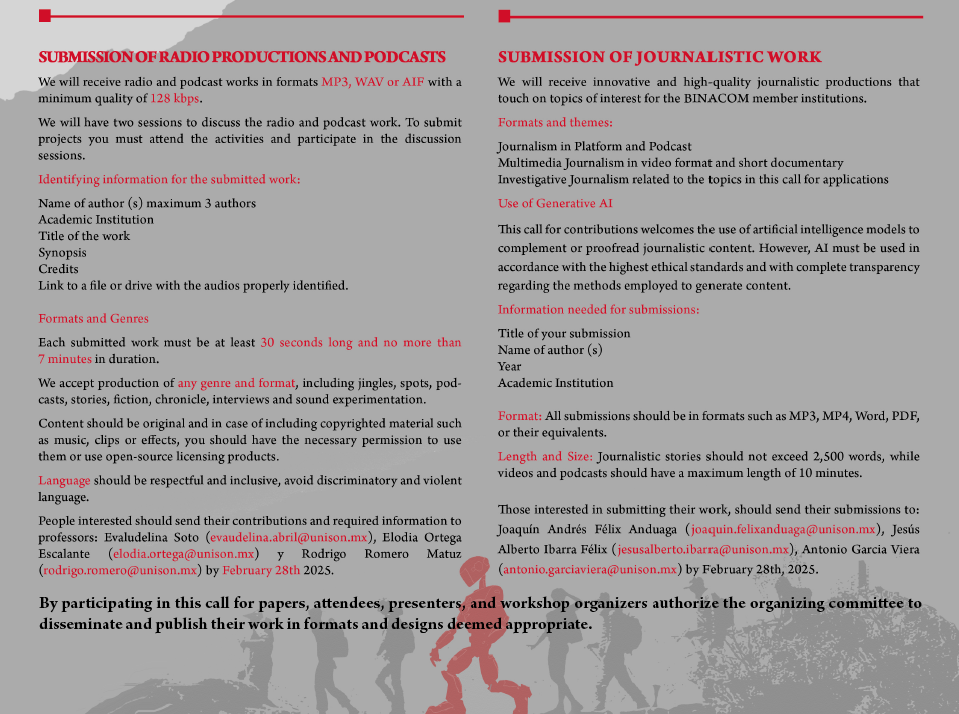
SUBMISSION OF RADIO PRODUCTIONS AND PODCASTS
We will receive radio and podcast works in formats MP3, WAV or AIF with a minimum quality of 128 kbps.
We will have two sessions to discuss the radio and podcast work. To send work, you should
Identifying information for the submitted work:
Name of author (s) maximum 3 authors
Academic Institution
Title of the work
Synopsis
Credits
Link to a file or drive with the audios properly identified.
Formats and Genres
Each submitted work must be at least 30 seconds long and no more than 7 minutes in duration.
We accept production of any genre and format, including jingles, spots, podcasts, stories, fiction, chronicle, interviews and sound experimentation.
Content should be original and in case of including copyrighted material such as music, clips or effects, you should have the necessary permission to use them or use open-source licensing products.
Language should be respectful and inclusive, avoid discriminatory and violent language.
People interested should send their contributions and required information to professors: Evaludelina Soto (evaudelina.abril@unison.mx), Elodia Ortega Escalante (elodia.ortega@unison.mx) y Rodrigo Romero Matuz (rodrigo.romero@unison.mx) by February 28th 2025.
SUBMISSION OF PHOTOGRAPHIC WORK
Photographic submissions will be received as digital files and printed for exhibition during the Encuentro (at no cost to participants)
Those who participate can submit up to two photos that will be printed at a maximum size of 8 to 11 inches.
Categories: Documentary photography, constructed photography, either individual or collective authorship.
Every entry should contain the following information:
Title of the photography
Name of author (s)
Year
Academic Institution
Description (100 words)
Photographs should be submitted in their original size, as captured by the camera, with a maximum file size of 8 MB per photo. The required format for photographs is JPG only
The photographic exhibition will be available during the Encuentro in the headquarters of the host organization, the University of Sonora.
Those interested should send their submissions to: Professor Joel Montoya (montoya@unison.mx, yonatan.robles@unison.mx, ignacio.castillo@unison.mx and denisse.najera@unison.mx) by February 28th 2025.
SUBMISSION OF JOURNALISTIC WORK
We will receive innovative and high-quality journalistic productions that touch on topics of interest for the BINACOM member institutions.
Formats and themes:
Journalism in Platform and Podcast
Multimedia Journalism in video format and short documentary
Investigative Journalism related to the topics in this call for applications
Use of Generative AI
This call for contributions welcomes the use of artificial intelligence models to complement or proofread journalistic content. However, AI must be used in accordance with the highest ethical standards and with complete transparency regarding the methods employed to generate content.
Information needed for submissions:
Title of your submission
Name of author (s)
Year
Academic Institution
Format: All submissions should be in formats such as MP3, MP4, Word, PDF, or their equivalents.
Length and Size: Journalistic stories should not exceed 2,500 words, while videos and podcasts should have a maximum length of 10 minutes.
Those interested in submitting their work, should send their submissions to: Joaquin Andres Felix Anduaga (joaquin.felixanduaga@unison.mx, Jesus Alberto Ibarra Felix (jesusalberto.ibarra@unison.mx, Antonio Garcia Viera (antonio.garciaviera@unison.mx) by February 28th, 2025.
By participating in this call for papers, attendees, presenters, and workshop organizers authorize the organizing committee to disseminate and publish their work in formats and designs deemed appropriate.